20–60kW DC Fast Charger Guide: Single vs Dual Guns
1) Quick answer (which one to choose)
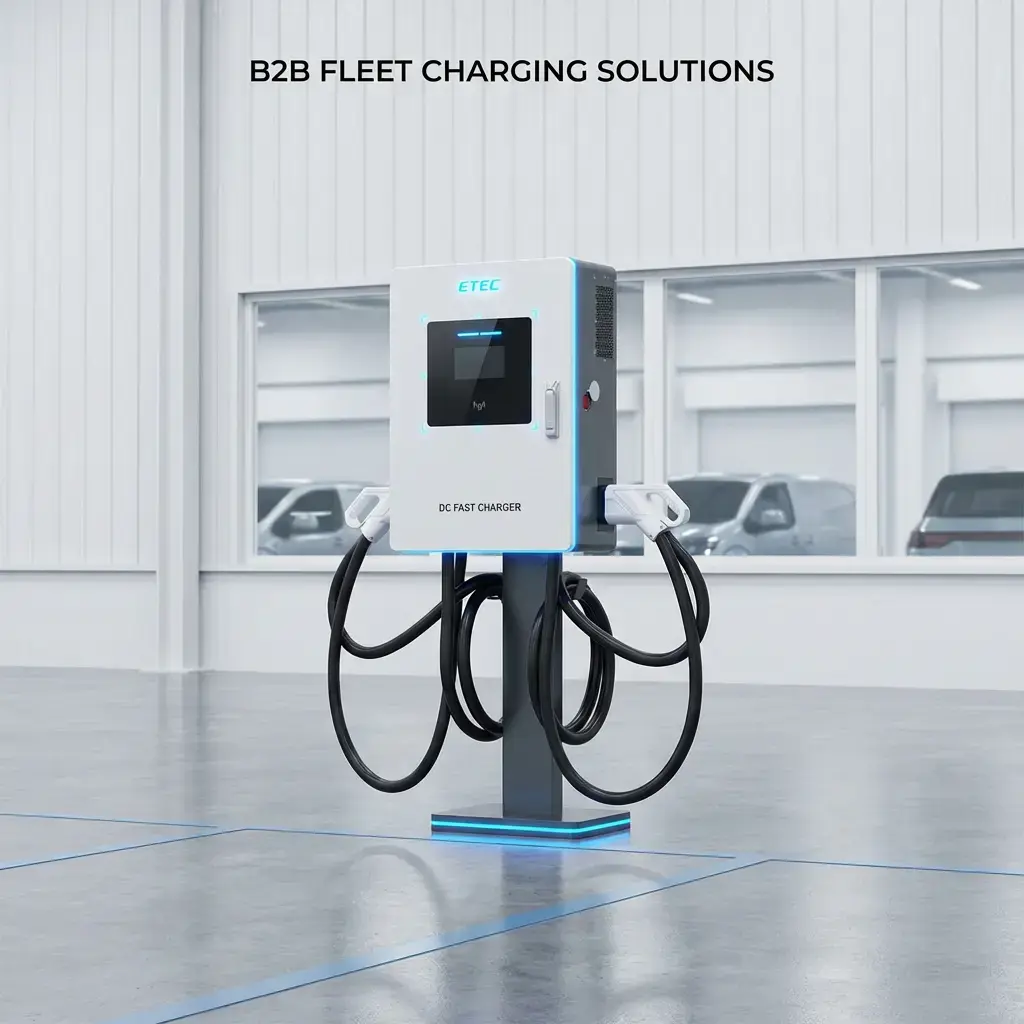
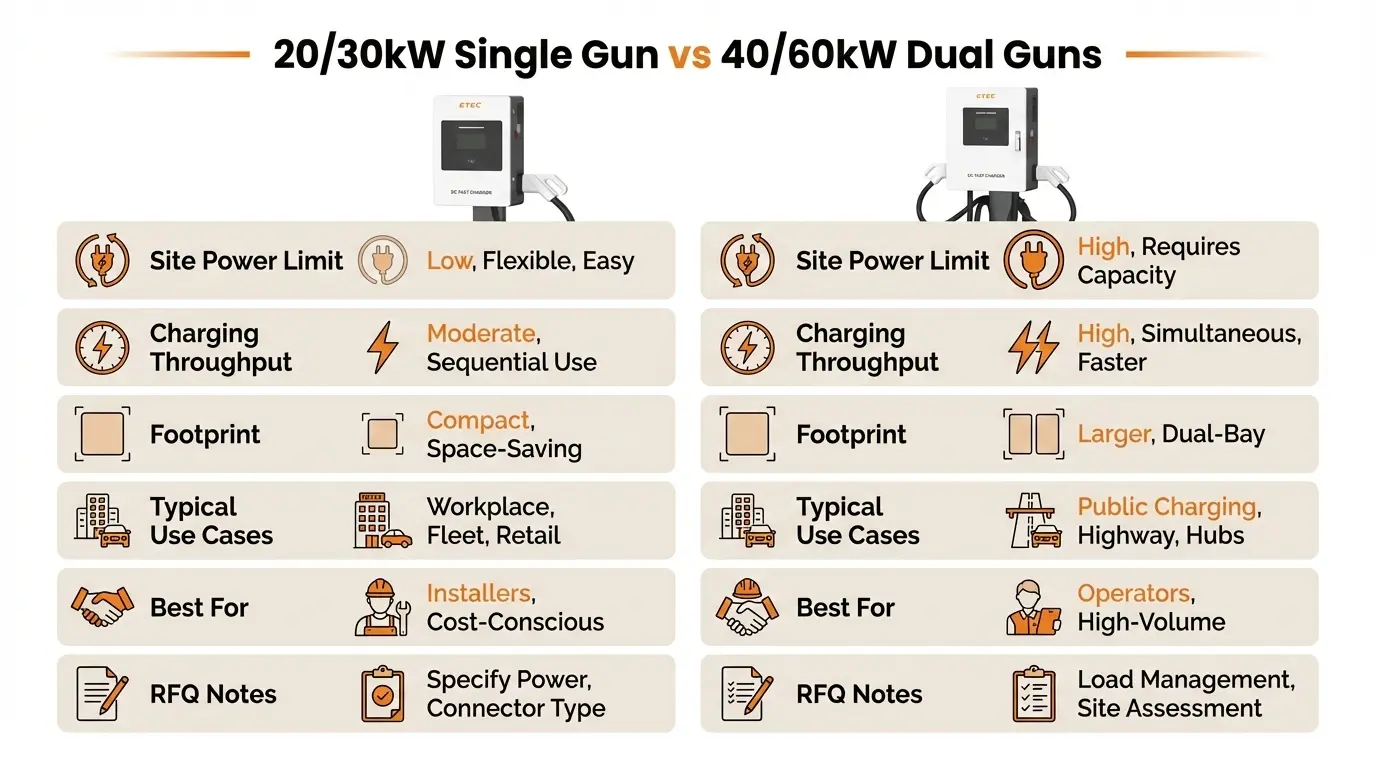
- Choose 20kW / 30kW (single gun) if your site has limited distribution capacity, you run a small fleet, or you want the simplest deployment with strong ROI.
- Choose 40kW / 60kW (dual guns) if you need higher daily throughput, fewer queues, and better charger utilization for operators and public/commercial parking sites.
This guide is written for project integrators, installers, and charging operators who need an engineering-style selection method plus a procurement-ready RFQ checklist. For ETEK product references, start from ETEK DC Fast EV Charging Station.
2) What to compare (power, outputs, site limits)
For 20–60kW compact DC fast chargers, the fastest way to avoid wrong procurement is to compare these items in one table:
- Site input: 3-phase supply availability and your distribution limitation (many compact units target around 380–415V 3P+N+PE in common markets).
- Outputs: single output vs dual outputs. In many dual-output designs, power/current may be shared when both guns charge at the same time—confirm the power-sharing behavior in your RFQ.
- Output range: voltage window and current limit (matters for compatibility and real charging curve performance).
- Connector strategy: CCS2 (EU / many Middle East), CCS1 (North America legacy), and other connector needs by region and vehicle mix.
- Uptime features: remote diagnostics, OTA updates, alarms, and how the charger reports faults.
- Environment: IP rating, impact rating (IK), temperature range, and installation method (wall/post).
- Compliance documents: certificates and test reports required by your target market and project owner.
ETEK’s EKDC1 product family is designed exactly around this decision point: 20/30kW single-gun and 40/60kW dual-gun, with Ethernet/4G/Wi-Fi options and OCPP 1.6J support: EKDC1 20–60kW Compact DC Fast Charger.
3) Best projects for 20/30kW single-gun DC chargers
Pick a 20kW/30kW single-gun configuration when you want the simplest, fastest deployment and predictable operations.
- Small fleet depots: vehicles return with similar SOC and have predictable dwell time.
- Industrial parks: charging is a facility add-on, not the core business—lower CAPEX is critical.
- Sites with strict power limits: single-gun reduces peak stress and simplifies protection & commissioning.
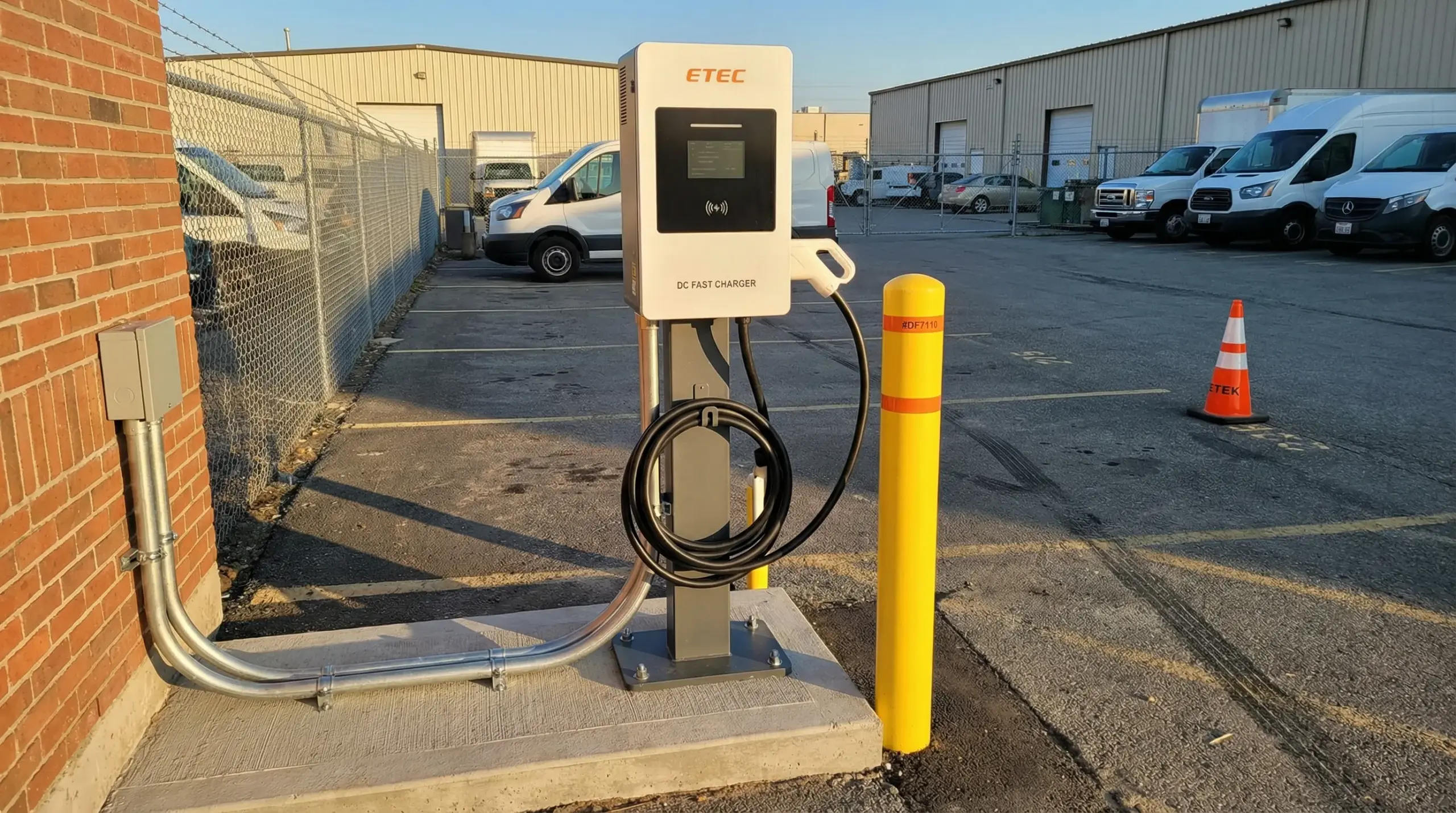
Integrator tip: If you expect growth, write your civil works and cable routes for future expansion. It’s cheaper to prepare now than to rework later.
4) Best projects for 40/60kW dual-gun DC chargers
Dual-gun compact DC chargers are about throughput and utilization. They reduce queues, increase daily sessions, and make a single footprint work harder.
- Commercial parking: two vehicles can charge in parallel, improving user experience and site revenue.
- Operator networks: utilization, uptime, and remote O&M matter more than “peak kW on paper”.
- Installer efficiency: one cabinet footprint can cover two bays (depending on cable reach and layout).
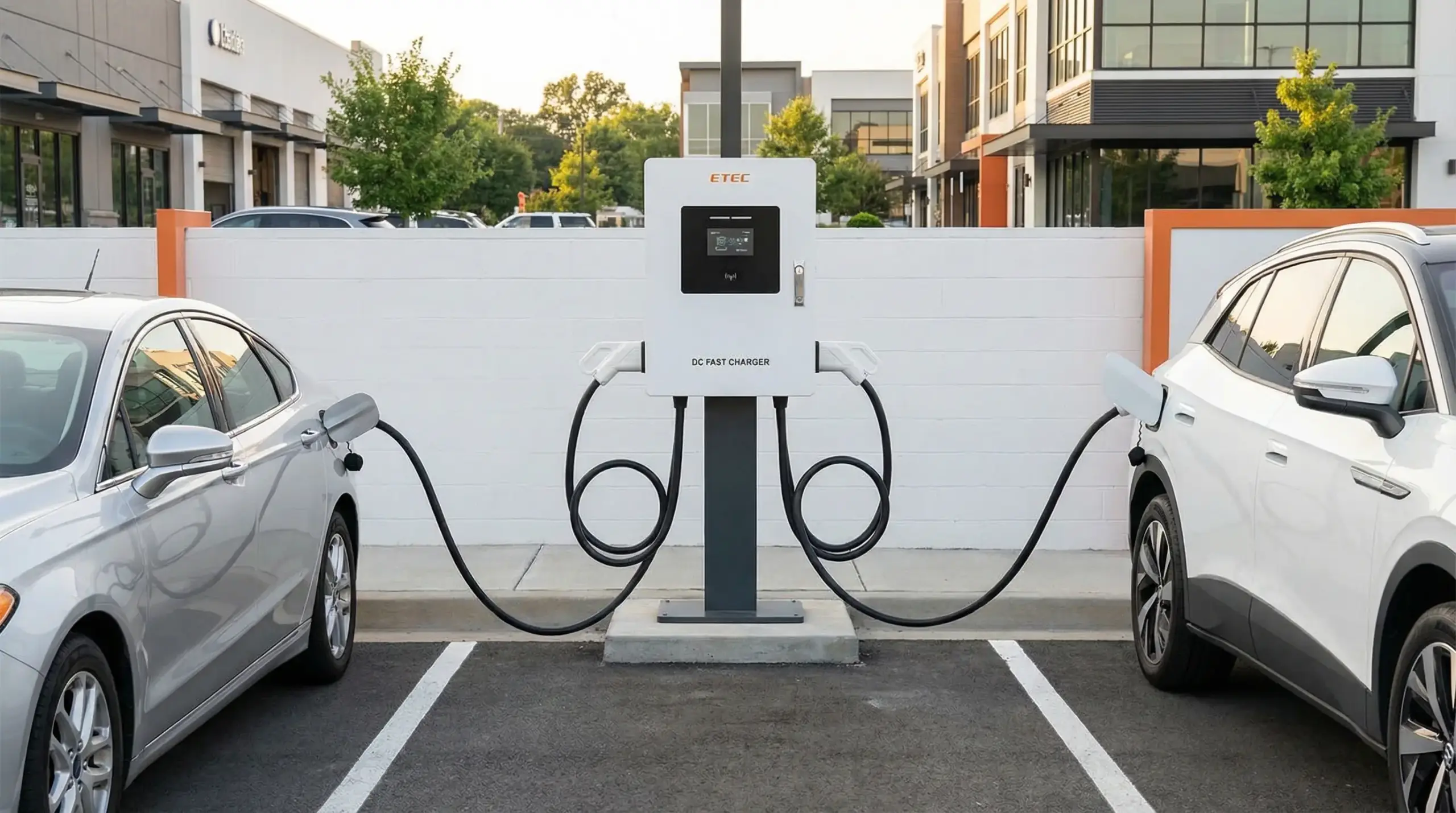
Important: In many dual-output designs, when both guns charge simultaneously, the charger may split current between outputs (for example, “reduced current per gun when both are active”). Don’t assume “60kW per gun”. Put the behavior in your RFQ.
5) Site electrical + installation checklist (installer-ready)
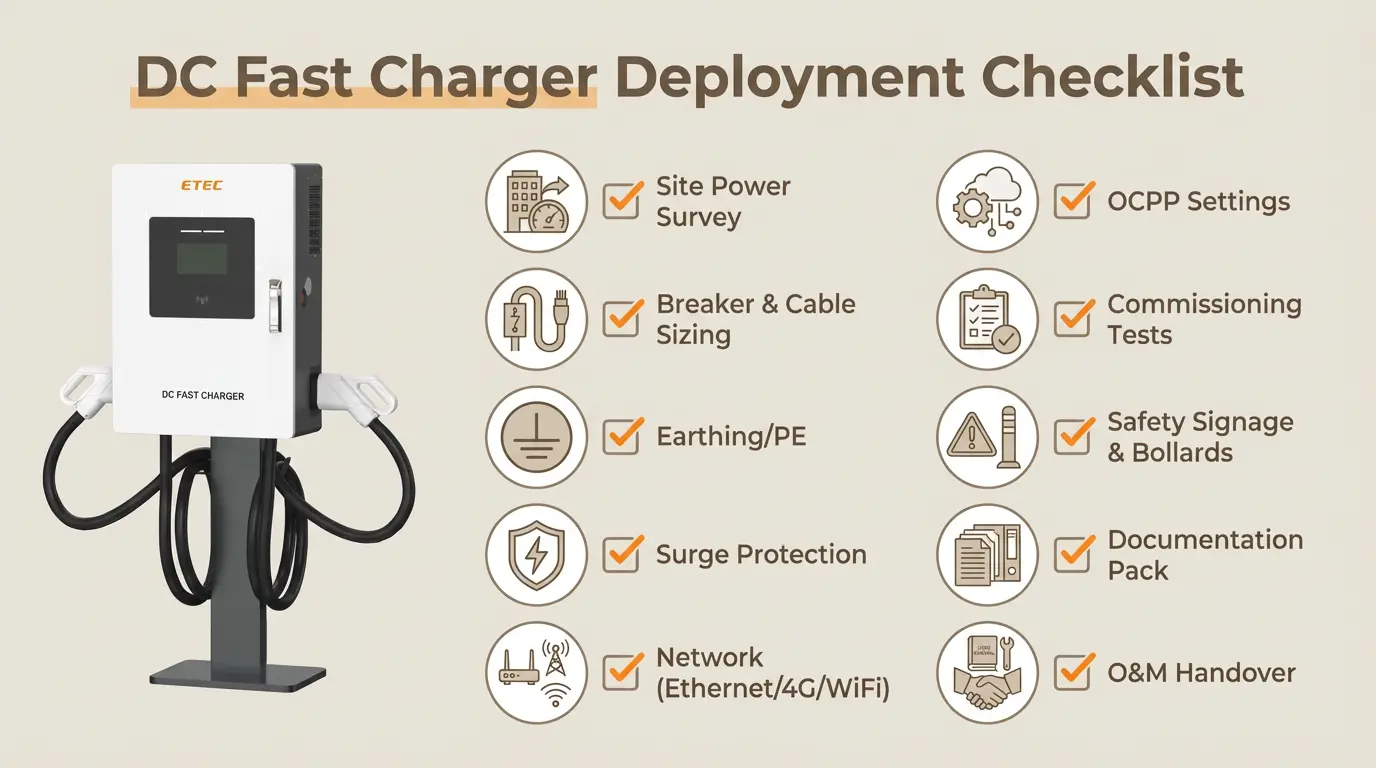
- Power survey: confirm transformer capacity, available feeder, and voltage stability under load.
- Protection design: coordinate breaker sizing, cable sizing, earthing/PE, and surge protection based on the site environment.
- Conduit and civil works: plan cable entry, bending radius, base mounting, and bollards for impact protection.
- Networking: decide Ethernet/4G/Wi-Fi, SIM plan (if 4G), and signal quality.
- Commissioning: insulation/earth continuity checks, functional tests, emergency stop, fault reporting, and back-office handshake.
6) Operations: OCPP, networking, and uptime
For operators and integrators, a DC charger is not only hardware—it’s an uptime system.
- OCPP requirements: specify OCPP version (many deployments use OCPP 1.6J) and the backend feature set you need (remote start/stop, alarms, firmware updates, meter values).
- Remote diagnostics: reduce truck rolls and speed up fault isolation.
- Data you want: session logs, fault codes, energy meter readings, and usage reports.
ETEK’s compact EKDC1 series description highlights OCPP support and multiple connectivity options, which is useful for operator deployments: EKDC1 Product Profile & Technical Data.
7) RFQ template (copy/paste)
Copy and paste this to get faster quotes and fewer clarification loops:
- Project type: operator / fleet depot / commercial parking / industrial park
- Target market: EU / Middle East / North America / South America
- Power: 20kW / 30kW (single gun) or 40kW / 60kW (dual guns)
- Connector: CCS2 / CCS1 / other (confirm by vehicle mix)
- Outputs behavior: confirm whether dual guns share power when both active
- Input supply: available voltage, phases, and site distribution limit
- Networking: Ethernet / 4G / Wi-Fi + SIM requirement
- Protocol: OCPP version + backend name (if already selected)
- Environment: indoor/outdoor, temperature range, IP/IK expectations
- Documents requested: certificates, test reports, warranty terms, commissioning checklist
For a fast response, use ETEK’s inquiry entry here: Send Inquiry (EKDC1 20–60kW) or Contact ETEK.
8) FAQ
Is 30kW “fast enough” for fleet projects?
Often yes—if dwell time is predictable and you plan charging windows. If you expect peak arrivals or need parallel sessions, 40–60kW dual guns usually improves throughput and operations.
Does a 60kW dual-gun charger always give 60kW on each gun?
No. Many dual-output chargers share power when both guns are active. Always ask the supplier to confirm the power-sharing logic and typical per-gun limits in your RFQ.
Which connector should I specify for EU vs North America?
EU projects commonly specify CCS2. North America can involve CCS1 and/or NACS depending on vehicles and network requirements. Your RFQ should list the vehicle mix and target market to avoid mismatch.
What should installers include to avoid rework?
Include the site power survey, protection coordination, conduit routing plan, networking plan, and commissioning test checklist in the project package from day one.
Sources
- ETEK: DC Fast EV Charging Station category
- ETEK: EKDC1 20–60kW compact DC fast charger (profile + technical data)
- BENY: 1 gun DC EV charging station (spec structure reference)
- JointCharging: Dual EV charger buying guide (utilization & queue framing)
- Panasonic: DC chargers 30kW/60kW (outputs & wiring reference)
- CNC Electric: EV charging solution page (terminology/solution framing)